
The software line is approved, so the event is funded—or so it seems. Then someone asks who will prepare terminology, test the venue feed, help attendees join, brief interpreters, and review the material shared afterward.
Those jobs may be performed by staff or volunteers, but they still need time and ownership. A useful multilingual-event budget makes the complete experience visible before the schedule becomes crowded.
This guide does not estimate market prices or recommend a subscription. It gives you a structure for collecting actual quotes, checking your account, and making informed tradeoffs.
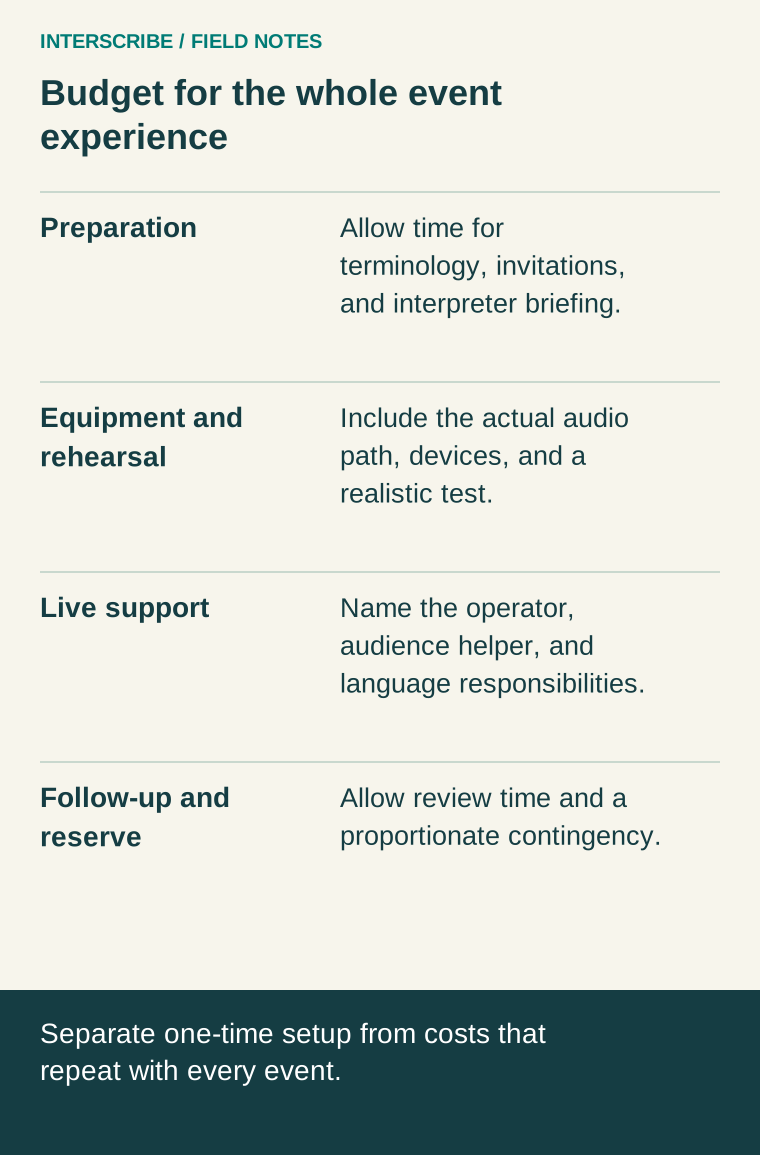
Separate setup from recurring work
Some work creates a reusable foundation: choosing the audio route, preparing welcome instructions, training operators, or building a rehearsal sheet. Other work repeats: briefing a guest speaker, updating terminology, staffing the live event, and reviewing follow-up material.
Keep these categories separate. Otherwise, a large first-event effort can make future events look more expensive than they are, or a low recurring software cost can hide repeated preparation labor.
Also distinguish a purchase from borrowed or already-owned equipment. “No new spending” does not mean no responsibility: someone still needs to reserve, transport, test, and return the equipment.
Budget the source before the output
List the microphone, mixer or interface, sending computer, network connection, and any needed adapters. Ask the venue what is included and who may operate it. Do not buy a new device to solve a routing problem you have not diagnosed.
Use getting good audio into InterScribe to understand the source path, then rehearse with the actual equipment. Include venue access time for that rehearsal. A free room for the event hour may still require a separate arrangement for preparation.
For remote interpreters, include their working setup and sound check in the plan. The Booth setup guide documents devices and listening choices, but equipment availability and professional preparation remain part of the human arrangement.
Count preparation as a deliverable
Write down what the preparation must produce:
- A confirmed audience-language and format plan.
- Accurate invitation and joining instructions.
- Names, terms, and relevant speaker material for language preparation.
- A completed source and attendee rehearsal.
- A live support assignment and a contingency decision.
- A review plan for anything distributed after the event.
Estimate time with the people who will do the work. Do not assume that a volunteer can absorb every task outside the visible event hour. If paid interpretation or specialist review is needed, obtain a quote for the actual scope rather than reducing the job to stage time alone.
A worked fictional effort estimate
Imagine a small organization planning a two-hour public workshop. For illustration only, its coordinator allocates two hours to invitation and audience planning, one hour to terminology preparation, one hour to a team rehearsal, three hours of operator availability including setup and pack-down, and one hour for follow-up review.
These are invented planning allowances, not typical prices or recommended staffing ratios. The organization asks each owner whether the allowance is realistic, then adjusts it to the actual event. Interpreter preparation and attendance are quoted separately because the required arrangement depends on languages, format, and working conditions.
The key discovery is that a two-hour event has work on both sides of the stage time. The team can now decide what to simplify without silently dropping necessary preparation.
Copy this budget worksheet
| Item | One-time or recurring? | Quantity or time | Source of estimate | Owner |
|---|---|---|---|---|
| Account/service | Verify actual agreement | Event requirements | Workspace and current quote | Account owner |
| Audio equipment | Purchase, hire, or existing | Exact devices/adapters | Venue inventory or supplier | Audio operator |
| Preparation | Mostly recurring | Agreed effort | Person doing the work | Organizer |
| Interpretation/review | Event-specific | Defined scope | Qualified provider | Language coordinator |
| Attendee support | Recurring | Setup and live coverage | Staffing plan | Welcome lead |
| Follow-up | Recurring | Material to review | Reviewer estimate | Content owner |
| Contingency | Event-specific | Named fallback | Actual availability | Event lead |
Add actual costs in your currency and record whether taxes, travel, or venue access are included. Avoid comparing quotes whose scopes differ.
Check account usage without guessing
Where relevant, InterScribe's hours and credits guide describes balances, session usage, and voice-hour planning. It documents AI voice usage while at least one listener hears a voice, alongside account-specific credit behavior.
Use the actual workspace and current commercial terms for your estimate. Do not multiply attendee count by event length and assume that is the billing rule. Confirm which features are available and whether the session's expected and worst-case estimates apply to your account.
Assign someone to check allowances before the event, rather than discovering a restriction during a live segment.
Make tradeoffs explicit
If resources are tight, reduce unnecessary complexity before removing a participant's essential route into the event. A simpler slide deck, clearer single-room schedule, or reusable invitation can reduce preparation work. Fewer last-minute changes can be more valuable than another feature.
Do not label an untested device or an unavailable volunteer as a free backup. A contingency needs a person, equipment, and a realistic activation step.
The existing conference interpreter equipment guide can help identify physical requirements. Bring those requirements into the same worksheet as people and preparation. A credible budget explains what the audience will receive, what it takes to deliver it, and which assumptions still need confirmation.