
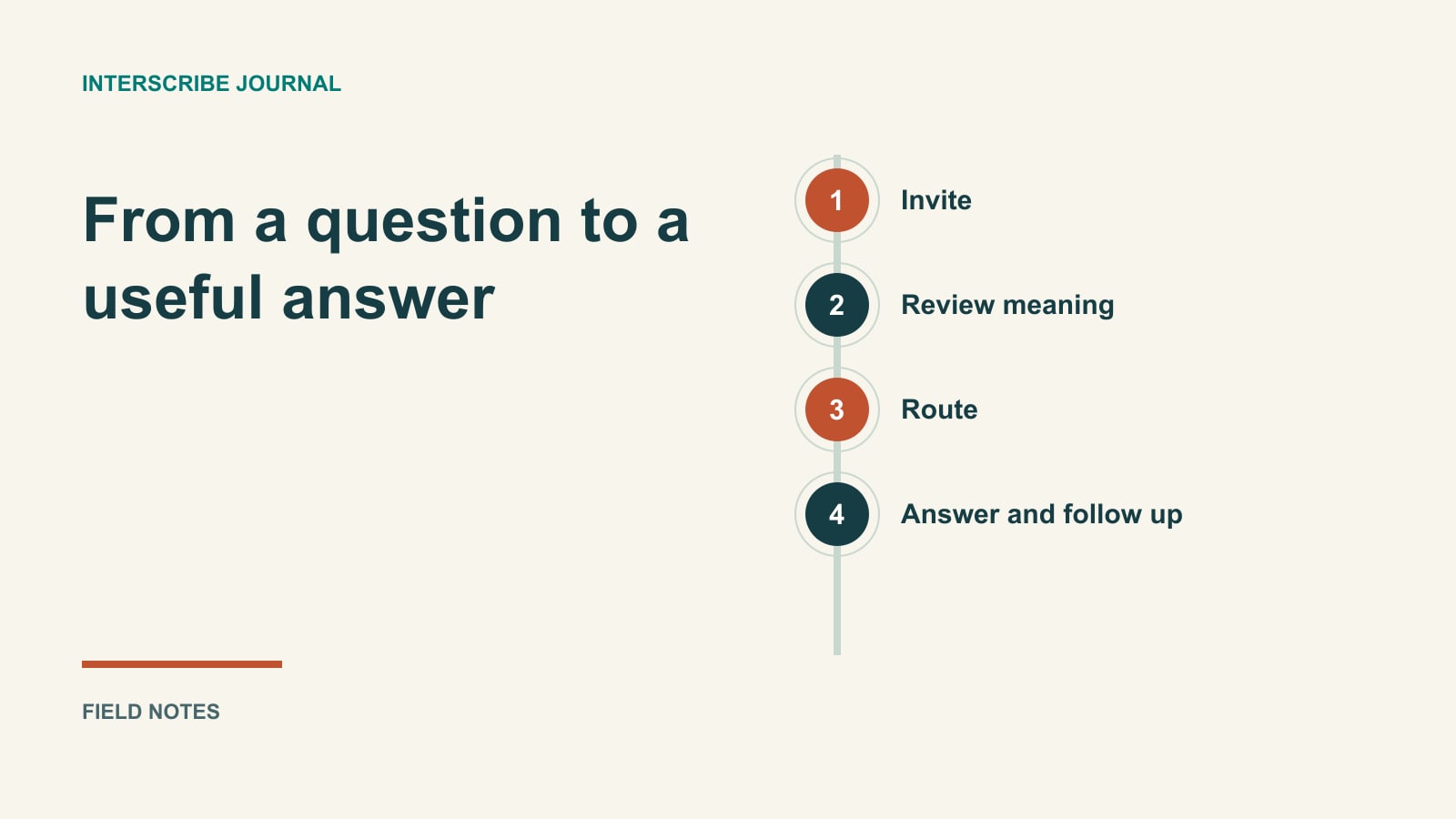
The presenter asks, “Any questions?” Three confident participants speak immediately. Someone else has a thoughtful question, but is still deciding how to phrase it in the presenter's language.
A multilingual Q&A can change who gets heard. It needs more than a translated question box, though. Participants need to understand the rules, moderators need a workable queue, and speakers need enough context to answer the question that was actually asked.
Decide how questions will enter the room
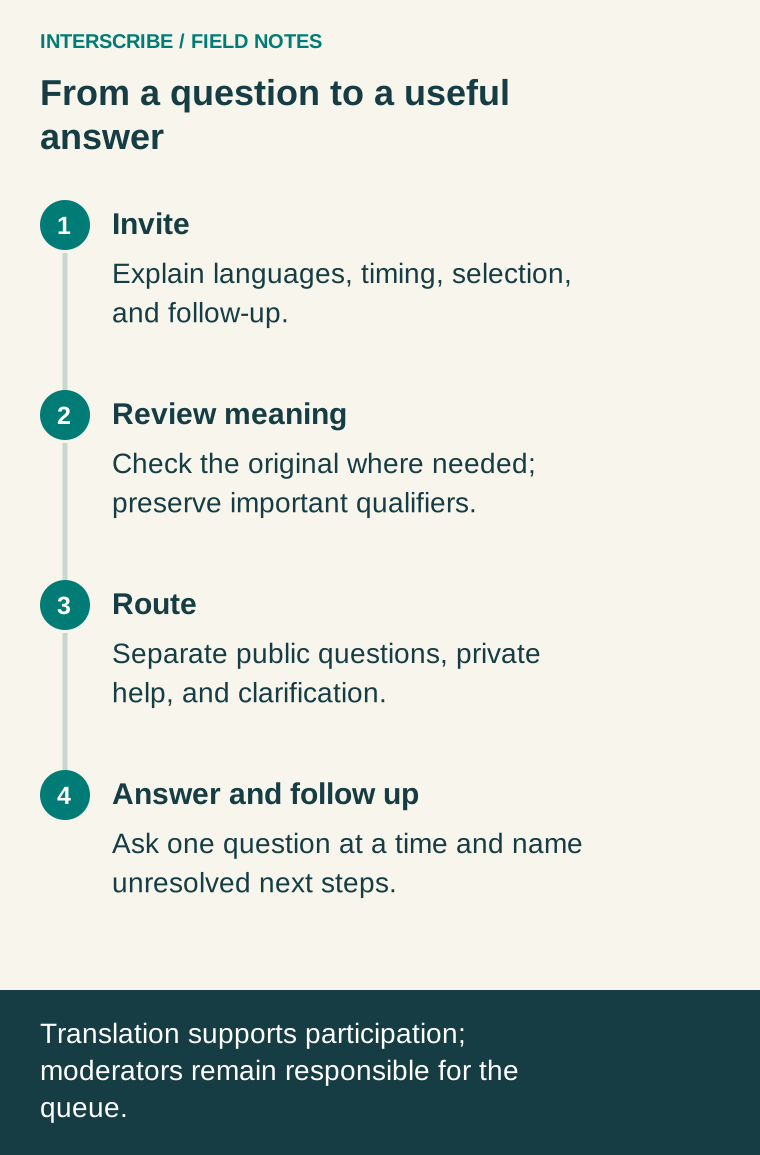
Choose whether questions will be collected throughout the talk, during a dedicated segment, or both. Tell attendees when answers will happen. A silent question queue can look broken when people expected an immediate reply.
InterScribe's chat, Q&A, and polls documentation describes translated messages and questions, with See original available to readers. It also describes question review, anonymous questions, and sign-in requirements. Check your session's actual settings: ordinary chat writing and Q&A participation can have different rules.
If you enable review before questions appear, assign someone to review them. A setting is not a moderator. If you cannot staff a continuous queue, announce a smaller submission window or a different process.
Write rules that protect useful participation
A good opening tells people four things: where to submit, which language they can use, how questions are selected, and what happens to unanswered questions.
For example:
“Please submit questions in the language you are most comfortable using. We will group repeated questions and choose across the main themes, rather than only taking the first submissions. Keep personal or confidential details out of the public question. We have fifteen minutes today; we will explain the follow-up route at the end.”
Do not promise a written response to every question unless someone owns that work. If anonymous questions are allowed, explain what is visible according to the session's settings rather than promising absolute anonymity.
Review meaning before polishing wording
A translated question may sound unusually direct, vague, or formal. Do not infer the writer's attitude from that alone. Read the original when you can, preserve specific details, and ask for clarification when the answer depends on an uncertain phrase.
Group duplicates carefully. “Will training be recorded?” and “Can I access training privately after my shift?” overlap, but the second contains an access concern that disappears if both become “Will there be a recording?”
Moderation also needs a boundary for private matters. Move individual support issues to the organization's approved support route instead of inviting more personal details into a public exchange.
A worked fictional queue
At an employee learning session, the queue contains these illustrative questions:
- “Can night-shift staff watch later?”
- “Will there be a replay?”
- “The Spanish audio stopped on my phone.”
- “Does the new process apply to contractors?”
The moderator combines the first two into a replay-and-access question, preserving the shift-work context. The audio problem goes to the help contact without requiring the presenter to troubleshoot a phone on stage. The contractor question remains separate because it changes who the answer applies to.
The moderator introduces the combined question: “Several people asked about watching later, especially colleagues working another shift. What will be available, and how will they access it?” That is more faithful than simply selecting the highest-ranked short question.
Use a small queue worksheet
| Field | What it prevents |
|---|---|
| Question/theme | Losing the underlying issue while editing |
| Original-language check needed? | Answering an uncertain translation as if certain |
| Important qualifier | Dropping details such as location, shift, or audience |
| Route | Public answer, private help, or clarification |
| Status | Repeating answers or overlooking follow-up |
| Follow-up owner | Making promises nobody fulfills |
Keep this worksheet within your organization's normal handling practices. You do not need to copy personal information to organize a question queue.
Give the speaker a manageable handoff
Read one question at a time, then pause. Long bundles create incomplete answers and make interpretation harder. If you combine questions, state the shared theme and the important exception. After the answer, summarize the action or unresolved point in plain language.
Give interpreters the session topic and likely terminology ahead of time. The bilingual staff interpretation guide provides related preparation ideas, although a bilingual volunteer's availability should not be treated as proof of interpreting competence.
Close the loop visibly
Before the session ends, say which topics remain unanswered and where the team will follow up. Check that any promised destination is accessible to the same audience that submitted questions.
Translation can widen participation, but it cannot decide which questions deserve attention or determine the correctness of a speaker's answer. Those remain human responsibilities. A well-run queue makes those responsibilities visible and manageable.