

A visitor follows the sermon comfortably, then the congregation stands to sing. The words move to the projection screen, the speaker stops explaining, and the visitor loses the thread.
Language access during a service is not only about translating the sermon. Lyrics, scripture references, responsive readings, and practical notices each ask something different of the listener. Preparing those moments together makes the service easier to follow without turning it into a technical demonstration.
Map the moments that depend on the screen
Take the service order and mark every point when understanding depends on projected text. Include songs, scripture, spoken responses, and instructions such as where children should go. For each, write the source of the text and who advances it.
Keep speech captions and slide text conceptually separate. Captions follow what is heard. A slide carries prepared words that may remain visible while music plays or nobody speaks. Sending one does not prove that the other is working.
The documented Slides workflow connects presentation software through a Slides station and offers Translated slides in session settings when available to the account. It also lets organizers choose whether to translate song lyrics and whether viewers may save or share slide images. Check those options in your workspace before promising them in visitor instructions.
Give each kind of text its own review
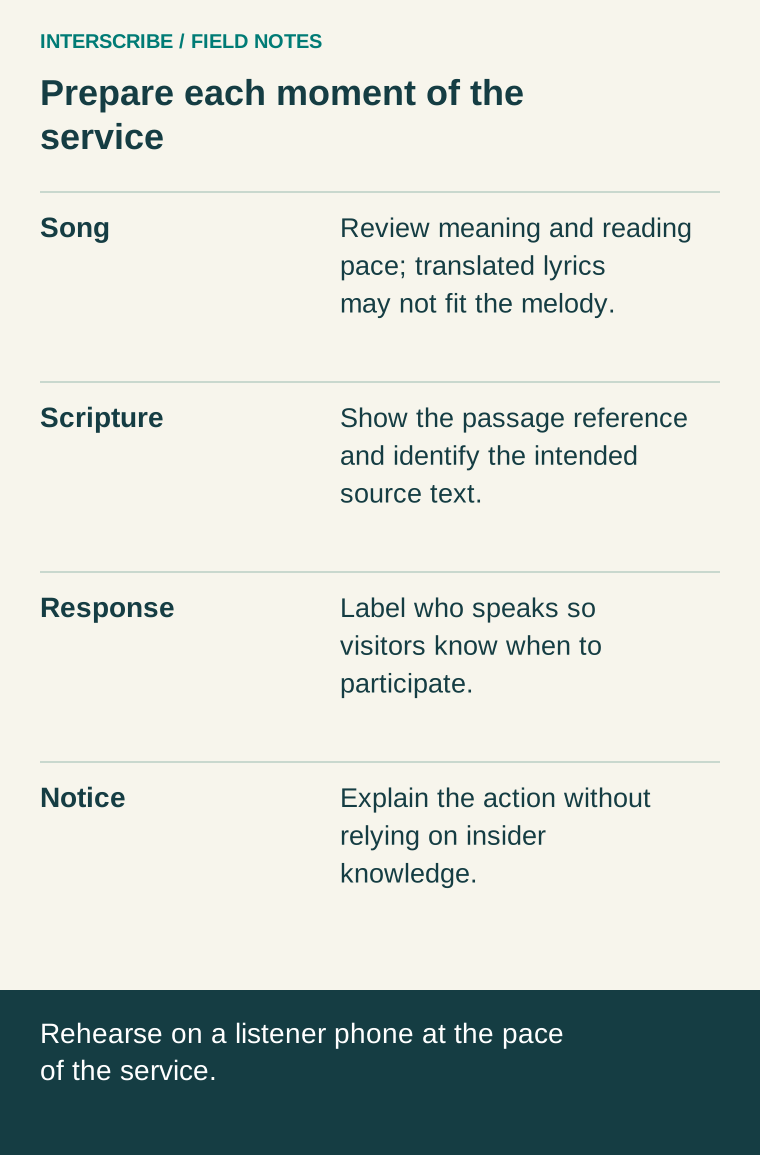
For a song, a translation can help someone understand the meaning without fitting the melody. Do not describe a machine-translated lyric as a singable adaptation. If you want a congregation to sing in another language, use appropriately reviewed material and follow your organization's permissions process.
For scripture, make the passage reference clear. A translated slide and a published Bible translation are not necessarily the same wording. Have the service leader decide which text is being read and how visitors can identify it. Avoid promising exact correspondence where you have not checked it.
For responsive readings, make the speaker role explicit: leader, congregation, or all. A person reading a translation needs to know when participation is expected, not simply what the words mean.
For notices, favor concrete wording. “Children meet at the blue door beside reception” is easier to act on than “usual arrangements apply.”
A worked fictional service
Imagine a congregation preparing a service with an opening song, a reading from Luke, a sermon, and a closing response. The slides operator and a bilingual volunteer rehearse from an attendee phone.
The song text arrives, but the volunteer notes that one line is too long to read before the next slide. The team changes the slide grouping. During the reading, the reference appears only on the first slide; a late-arriving reader cannot identify the passage. The team adds a clear reference at the transition. The closing response does not distinguish the leader's part from the congregation's, so they label both.
None of those improvements requires an invented accuracy score. Each removes an observable obstacle to participation.
Rehearse at the pace of the service
Do not click through the deck rapidly just to confirm that something appears. Have someone read and sing at the expected pace while the operator advances normally. On a phone, check whether a person can identify the slide type, read the text, and return attention to the room.
The documented listener controls include viewing original or translated text, opening a slide full width, adjusting slide size, and hiding slides. Show the welcome team those options so they can help someone who wants fewer visual distractions. Refer to reading comfort settings for caption adjustments; a useful experience may require both.
Copy this service-text review sheet
| Moment | Review question | Responsible person |
|---|---|---|
| Song | Is the intended meaning understandable, and is the reading pace realistic? | Music leader and bilingual reviewer |
| Scripture | Is the reference visible and the intended source text identified? | Reader or service leader |
| Response | Can a visitor tell when the congregation speaks? | Service leader |
| Notice | Does the text explain the action without insider knowledge? | Welcome coordinator |
| Slide transition | Did the correct content reach the attendee phone? | Slides operator |
| Sharing | Are save/share choices appropriate for this material? | Organizer |
Add a column for the actual correction and a retest mark. “Reviewed” without a recorded observation can hide a missed issue.
Prepare a simple welcome explanation
Try: “You can read the service in your preferred language on your phone. Slides may appear alongside the captions. You can choose the original text or the translation, and adjust the size. Please ask the welcome team if you cannot find the passage.”
Only mention functions you have confirmed in that session. Avoid making visitors feel responsible for debugging your setup.
For deeper preparation of church-specific terms, the existing theological terminology guide is a useful companion. Treat translated service text as material to prepare and review, not a substitute for pastoral judgment or an assumption that every visitor reads comfortably on a phone.