
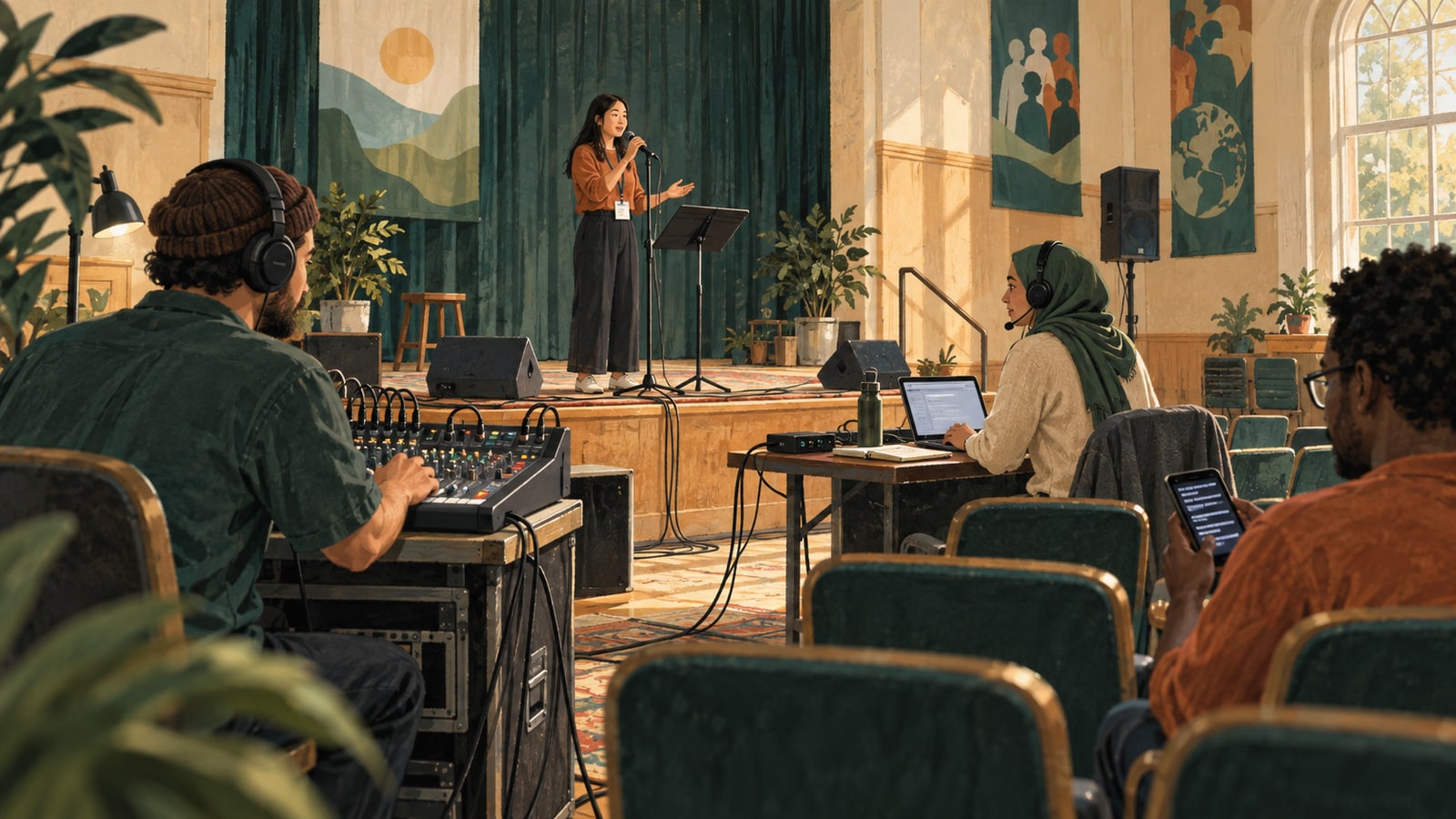
At rehearsal, everyone is standing around the sound desk. The microphone works, a caption appears, and someone says, “Looks good.” On event day, the welcome volunteer cannot explain the joining code, the interpreter cannot hear a guest microphone, and nobody knows who should respond.
The equipment was tested. The team was not.
A useful rehearsal distributes people across the experience they are responsible for. Give each person a job, an observable outcome, and a clear handoff when that outcome fails.
Assign roles before assigning devices
Use four roles, even if a small team combines some of them:
- Organizer: owns the session, audience instructions, and decisions about proceeding.
- Audio operator: verifies the source and keeps the sound path stable.
- Interpreter or language reviewer: checks the relevant listening and language experience.
- Attendee tester: joins as an ordinary guest and reports what happens without relying on organizer access.
One person can prepare several things before the event. During a live failure, however, answering attendee questions and changing the production audio can compete for attention. Identify that conflict in rehearsal instead of discovering it in front of the audience.
The event-day checklist provides the product-side reference. Your run sheet adds names, timing, and local responsibilities.
Start with the invitation, not the microphone
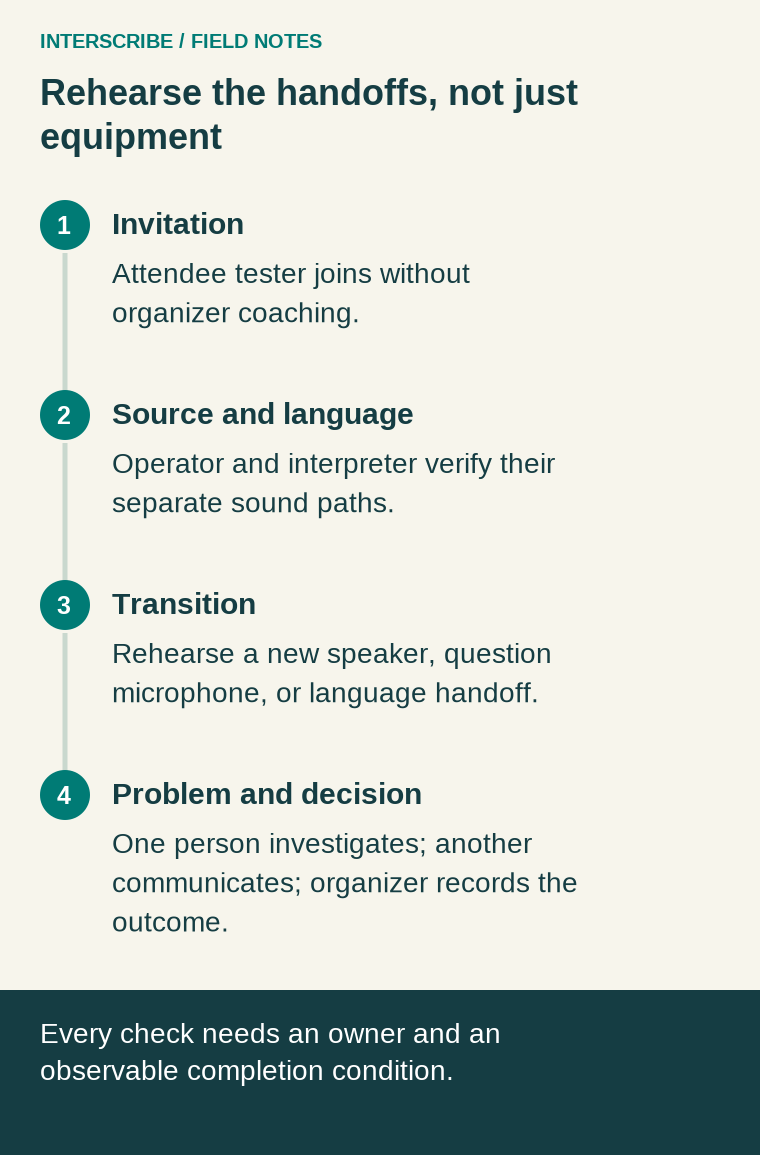
Hand the attendee tester the exact message, poster, or QR code you plan to distribute. Ask them to join without coaching. Watch where they hesitate, then ask what they expected to happen.
Confirm the session, language choice, and any access instructions. Test the ordinary attendee route rather than a saved administrator tab. Use the joining documentation to check how links and codes behave.
A tester who needs three verbal corrections has found three pieces of missing information. Rewrite those instructions before repeating the test. Do not count a coached success as proof that the original instructions work.
Rehearse one realistic segment
Read a short passage using the actual lectern or headset. Include a person's name, a number, a transition to another microphone, and one prepared visual if slides are part of the event. Ask the attendee tester to report which speaker they followed and what action they understood.
An interpreter should test their own microphone, headphones, and listening selection. The Booth setup guide explains the private microphone check and how to choose the floor or a relay channel. A successful venue check cannot establish that a remote interpreter's devices are correct.
Then rehearse the transition: a second speaker, a question microphone, or a language handoff. Static tests miss failures that happen when responsibility changes.
A worked fictional rehearsal
A volunteer team prepares a community presentation. Lina owns the session and welcome instructions. Mateo operates audio. Priya interprets remotely. Owen joins on a phone from the back of the room.
The opening passage works. During questions, Owen sees no new speech because the handheld microphone is not included in the mixer feed. Mateo corrects the route. Lina changes the run sheet to require a handheld check before every session. Priya confirms the floor is audible after the change, and Owen repeats the attendee check.
The team records one defect, one owner, one correction, and one retest. It does not restart every unrelated check or declare that “the platform had an issue.”
Copy this rehearsal run sheet
| Stage | Owner | Observable completion |
|---|---|---|
| Invitation | Attendee tester | Reaches intended session without organizer coaching |
| Source audio | Audio operator | Each planned microphone reaches the selected session |
| Language experience | Interpreter/reviewer | Can hear the intended source and verify a representative passage |
| Audience settings | Attendee tester | Finds language and reading controls on their own device |
| Transition | Organizer | Announces speaker or segment change; team follows agreed handoff |
| Problem response | Organizer and operator | One person investigates; another communicates |
| Close | Organizer | Records unresolved issues, owners, and proceed decision |
Add the actual names and the date at the top. A role without an assigned person is an unfilled task.
Introduce one controlled problem
In a private rehearsal, choose a reversible scenario: the attendee opens an old link, the presenter forgets the handheld, or the tester cannot find the language setting. Explain the exercise beforehand and avoid disrupting other live sessions.
Watch the response. Does everyone speak at once? Does the operator abandon the desk? Does the attendee receive a clear explanation? The point is to improve coordination, not to surprise or embarrass volunteers.
Use a short response phrase: “I am checking the source. Please keep the attendee informed. I will report back before anyone changes another setting.”
Finish with a decision, not a feeling
List unresolved issues by consequence. A cosmetic poster improvement can wait; a missing question microphone or inaccessible joining route cannot be waved away because the rehearsal ran out of time.
Record what must be fixed, who will verify it, and whether it affects the event plan. Keep the volunteer interpreter training guide as a companion for preparation beyond the technical rehearsal.
A team is ready when each person knows what success looks like and what to do when their part fails. More people around one laptop does not create that clarity.