
The heart of God for the stranger and the nations.
Scripture tells a sweeping story of the nations: people scattered at Babel, people hearing God’s works in their own languages at Pentecost, and a multitude from every nation and tongue gathered before the throne. Alongside it runs a command repeated again and again: love the stranger, and welcome them in. These passages are why we care about understanding and belonging. This study reads each one, says what it meant, and asks what it might ask of a church today.
How to read each passage
The passage
Quoted from the King James Version, with the reference. Read it in your own Bible too.
What it says
What the text meant in its own setting, kept apart from how we apply it.
What it asks of a church
One plain sentence of application. An application, not a command from the text.


- Babel
- Pentecost
- Every nation before the throne
Part 1 · The story of language
From Babel, to Pentecost, to every nation before the throne.
Three moments, read in order, trace how Scripture treats language and the nations. They are a thematic thread, not a claim that any tool continues them.
Chapter 1 · Genesis 11:1–9
Babel: a people scattered
Therefore is the name of it called Babel; because the LORD did there confound the language of all the earth: and from thence did the LORD scatter them abroad upon the face of all the earth.
Genesis 11:9 · King James Version What it says. Humanity, sharing one language, sets out to make a name for itself. God confuses their speech and scatters them. The story judges a particular pride; it does not teach that many languages are a curse.
Handle with care: No software “reverses Babel”, and we will never say it does.
Chapter 2 · Acts 2:1–12
Pentecost: every one in their own tongue
And how hear we every man in our own tongue, wherein we were born?
Acts 2:8 · King James Version What it says. By the Holy Spirit, visitors from many nations hear the wonderful works of God in their native languages. The languages are not erased. Each person is reached in their own.
Handle with care: Pentecost was a work of the Spirit. A translation service is not Pentecost, and it is not a spiritual gift.
Chapter 3 · Revelation 7:9–10
A multitude no one could number
After this I beheld, and, lo, a great multitude, which no man could number, of all nations, and kindreds, and people, and tongues, stood before the throne, and before the Lamb.
Revelation 7:9 · King James Version What it says. The story ends with worship from every nation and tongue. Unity, and the nations still recognisable. It describes God’s victory, not a goal anyone can reach with a product.
Handle with care: The same verse closes the Great Commission page, where it is the horizon of the mission.
Part 2 · The stranger at the door
“Love ye therefore the stranger.”
Seven passages, from the Law to the letters, about the person who arrives from somewhere else. Under each one: what it might ask of a church on an ordinary Sunday.
The Law
But the stranger that dwelleth with you shall be unto you as one born among you, and thou shalt love him as thyself; for ye were strangers in the land of Egypt.
Leviticus 19:34 · King James Version What it asks of a church today. Treat the one visitor who does not speak your language as one of your own, not as an edge case too small to plan for.
The Law
He doth execute the judgment of the fatherless and widow, and loveth the stranger, in giving him food and raiment. Love ye therefore the stranger: for ye were strangers in the land of Egypt.
Deuteronomy 10:18–19 · King James Version What it asks of a church today. Let welcome come from God’s own care for the overlooked, not from how many people a service will reach.
The Prophets
For mine house shall be called an house of prayer for all people.
Isaiah 56:7 · King James Version What it asks of a church today. Ask whether people outside your main language can take part in worship, not only sit through it.
The Gospels
I was a stranger, and ye took me in.
Matthew 25:35 · King James Version What it asks of a church today. Judge your welcome by what the visitor actually experiences, not by the sign on the door.
The Letters
Be not forgetful to entertain strangers: for thereby some have entertained angels unawares.
Hebrews 13:2 · King James Version What it asks of a church today. Prepare before the unexpected guest arrives, instead of waiting until someone asks twice.
The Letters
Now therefore ye are no more strangers and foreigners, but fellowcitizens with the saints, and of the household of God.
Ephesians 2:19 · King James Version What it asks of a church today. Getting into the building is not the same as belonging. Aim for understanding and taking part.
Intelligible worship
So likewise ye, except ye utter by the tongue words easy to be understood, how shall it be known what is spoken? for ye shall speak into the air.
1 Corinthians 14:9 · King James Version What it asks of a church today. Paul’s subject is tongues in public worship, and we do not blur that. His principle still stands: the gathered church is built up by words people can understand.
Picture this
Sunday, 10:40. Hebrews 13:2, on an ordinary morning.
For example
10:40
A mother and her teenage son, three weeks in the country from Angola, sit down in row nine. They speak Portuguese. Nobody knew they were coming.
10:41
A welcome-team volunteer points to the QR code on the screen. The son scans it, picks Português, and the pastor’s words arrive on his phone as they are spoken. His mother leans over to read along.
10:42
Nothing about the service changed. The church had simply set the code up the month before, for a family it had not met yet.
- Choose Your portal: one QR for the screen
- Always shows today’s service
- Português · captions
- AI voice, if they want to listen
- No app to install
Part 3 · Two jobs for a church
Two equally important jobs.
Serve the people already here. Prepare for the people yet to arrive. Neither is the more faithful one. Readiness is hospitality, not a test of spirituality, and a church without a budget for it has nothing to feel guilty about.
Every week, dependably
Serve those already here
- Who it is for
- Multilingual members, families and volunteers who are in the room every Sunday.
- What it looks like
- Captions, AI voice and your own interpreters in the same languages each week, with your names and terms kept right.
- What success means
- People follow the teaching, stay, and come back. It works every week without a scramble.
Ready before the need
Prepare for those yet to arrive
- Who it is for
- The visitor nobody expected, who understands little of the language being spoken.
- What it looks like
- Your portal’s QR already on the screen, a sound desk already connected, a welcome team that knows what to say.
- What success means
- The guest finds the way in by themselves, and it starts within the service, not next month.
Honest note: a QR code alone does not make translation happen. The sound has to reach us and someone has to press start. Be ready walks through that.
Guardrails
What InterScribe is not.
We would rather say this plainly than have you find it out on a Sunday. Translation removes a barrier. Everything that matters most is still yours, and God’s.
Not the Holy Spirit
It carries words from one language to another. It does not give revelation or spiritual understanding, and it is not Pentecost.
Not pastoral care
A caption cannot sit with someone after the service. People still need a person who greets them, prays with them and follows up.
Not discernment
Interpreting the Word, and deciding what a passage means for your people, stays with your pastors and leaders.
AI can be wrong
Especially on Scripture quotations, names, sung worship and fast speech. Add your names and terms to a vocabulary, put the reference on the slide, and keep a human interpreter where it matters most.
Why we build this
A place for every nation. A welcome in every language.
InterScribe started in a church community, with one person who could not follow what was being said. These passages are why we keep building. You do not have to share our faith to use what we make; we simply want you to know where it comes from.
Read our vision and mandateFrom study to Sunday
The mission
The Great Commission, in every language they speak
For conferences, missions and networks carrying the message across borders.
Read the pageHebrews 13:2, in practice
Be ready for the person you haven’t met yet
A checklist for churches with no regular need today.
Be ready1 Corinthians 14:9, in practice
Preach to every nation in real time
How the sermon reaches every phone, every week.
Sermon translation
Questions pastors ask us
Talk to a personWhy the King James Version?
It is in the public domain, so we can quote it in full, and its wording is familiar across many churches. Read each passage in the translation your church uses as well; the references are there for that.
Do we have to share your faith to use InterScribe?
No. You do not have to share our faith to use what we make, and nothing in the product asks you to. We simply want you to know why we care.
Are you saying a church without translation is unfaithful?
No. Readiness is hospitality, not a measure of faith. A church without a budget for it has nothing to feel guilty about.
How does InterScribe handle Scripture quotations in a sermon?
It translates the words the pastor says; it does not look up a published Bible translation. A quoted verse may not match the wording a guest knows. Add names and terms to a vocabulary, put the reference on the slide, and keep a human interpreter where it matters most.
Your doors are open to everyone. Is your message?
Tell us about your church and who walks through your doors. We’ll talk through what would actually help, including whether you need us at all yet.
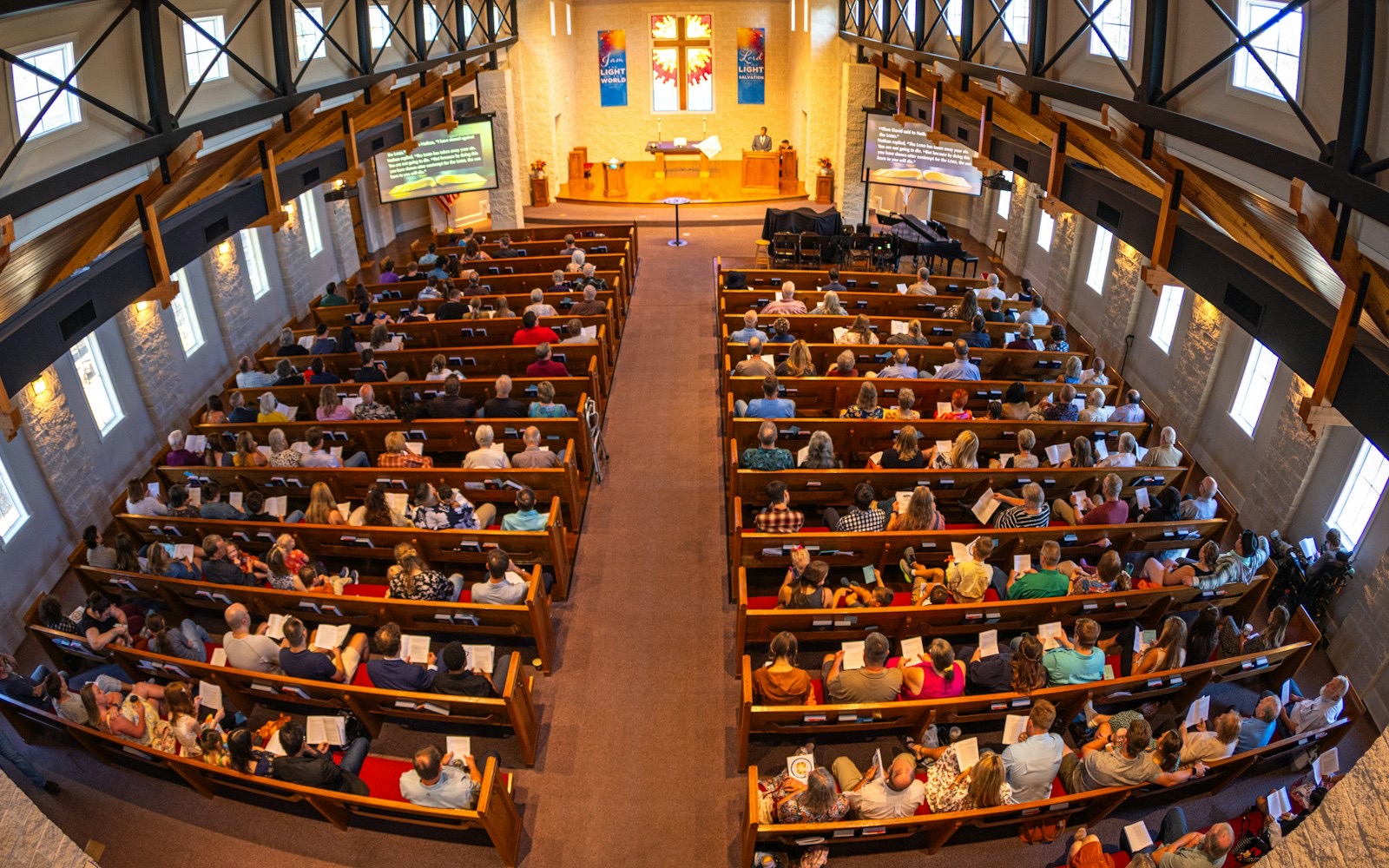
Church section
The whole sermon, for every family in the room.
Pages for pastors and church leaders: how a Sunday works, being ready for the visitor you have not met, captions, taking part, the mission and what Scripture says.
Photos: Benito Sanity, Rod Long and Stephanie Hernandez on Unsplash