

Ask where participation breaks down
If you introduce another language option and attendance rises, it is tempting to attribute the increase to the new service. The topic, invitation list, timing or promotional effort may also have changed. If attendance falls, that does not prove the service was unhelpful to the people who needed it.
A useful pilot asks a narrower question: which part of the webinar journey became easier, for whom, and what evidence supports the next decision? This guide provides a measurement funnel and a fictional calculation worksheet. It does not report customer results or promise an attendance increase.
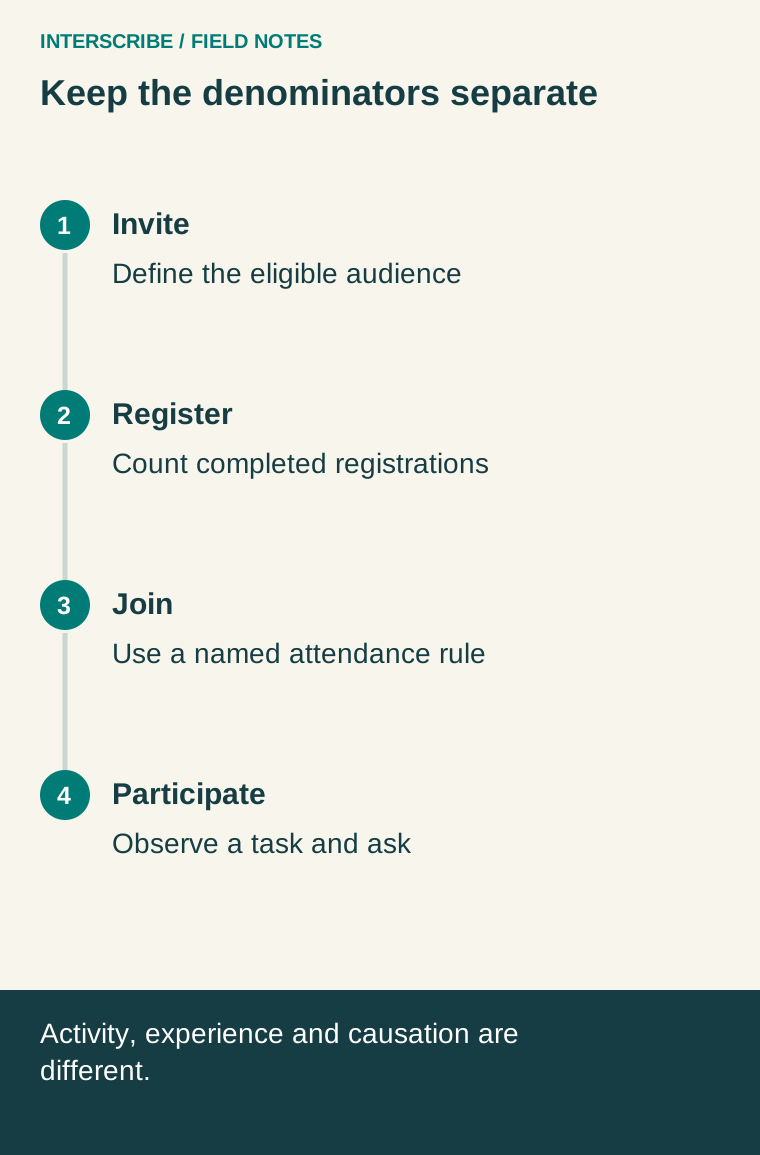
Separate the stages and their data sources
An invitation is not a registration. A registration is not an arrival. A connection is not proof that someone followed the content or had a chance to ask a question.
Use the registration system for registrations, the relevant meeting system for its defined attendance records, and a language service's report for its defined channel activity. Keep the definitions next to the numbers rather than merging exports into an unexplained total.
| Stage | Example measure | Definition to settle first |
|---|---|---|
| Invitation | People eligible to receive the campaign | Delivered messages, addresses or deduplicated people? |
| Registration | Completed registrations | Unique people, registrations or ticket records? |
| Join | Registrants recorded as attending | Which system and matching rule identify attendance? |
| Follow | Participant reports completing the intended learning task | Who responded and what was asked? |
| Interact | A defined question or task attempt | People, questions, attempts or successful outcomes? |
Pick a small set of measures that can inform an action. A large dashboard with incompatible denominators can make a weak conclusion look precise.
A fictional two-webinar calculation
Consider two fictional webinars with the same broad subject and invitation pool. Webinar A has 100 registrations and 60 matched registered attendees. Webinar B, which advertises an additional language arrangement, has 120 registrations and 78 matched registered attendees.
The registration-to-attendance rate is 60 ÷ 100 = 60% for A and 78 ÷ 120 = 65% for B. The difference is 5 percentage points. Relative to the first rate, that is approximately an 8.3% relative increase: (65 − 60) ÷ 60. The attendee count itself rises by 18, or 30% of the original 60.
Those are three different descriptions. None alone establishes that language support caused the change. Suppose B also had a better-known speaker and an extra reminder email; both belong in the comparison notes.
| Fictional measure | Webinar A | Webinar B | Honest interpretation |
|---|---|---|---|
| Registrations | 100 | 120 | More registrations, cause not isolated |
| Matched registered attendees | 60 | 78 | 18 more recorded attendees |
| Registration-to-attendance rate | 60% | 65% | 5 percentage-point difference |
| Additional changes | Baseline invitation | New speaker and reminder | Comparison is confounded |
Do not mix anonymous browser counts into the matched-attendee numerator. If matching is unavailable, use a differently named measure and state that limitation.
Ask about language needs directly
At registration, offer a clear way to request a language or format and an appropriate private route for individual arrangements. Avoid inferring need from a country, name or browser language. Explain what the event can currently provide and how unconfirmed requests will be handled.
A participant may use more than one language or switch between text and audio. Language-choice counts may therefore overlap, depending on the report definition. Do not sum them into a unique-person total without verifying that the categories are mutually exclusive.
Low observed usage deserves investigation. Perhaps the joining instructions were unclear, the advertised option was difficult to find, or the person who requested it could not attend. A universal cutoff for removing a language would ignore these possibilities and individual commitments.
Check what channel analytics actually count
InterScribe's analytics documentation distinguishes People, counted as distinct browsers opening a channel, from Connections, which counts connection events. It also distinguishes caption output from listening modes and tells readers to inspect How we count for the applicable rule.
Use those definitions in the pilot record. A reconnecting browser and a participant using multiple devices can affect different figures differently. “Languages published” describes produced output, not a verified count of people who understood it.
The documentation is a guide to the product's reporting concepts, not a live audit of your account's data. Confirm the report, date range and permissions in the environment you use, then retain the definitions with the exported or recorded result.
Add one participant task and one focused question
Choose a task appropriate to the webinar: find a procedure, explain a key condition or submit a question before the discussion closes. Rehearse it with people using the advertised language arrangement, and invite voluntary feedback after the event.
For example, ask “Could you follow the demonstration well enough to identify the next step?” with a way to explain a problem. Report the respondent count. If 12 people respond and 9 say yes, that is 9 of 12 respondents, or 75%; it is not 75% of all attendees unless all attendees responded.
Keep comments that reveal failures, even if most responses are favorable. One unresolved participation arrangement can require action without changing an aggregate average very much.
Copy this pilot decision record
| Field | What to record |
|---|---|
| Question | The stage or task language support is intended to improve |
| Arrangement | Advertised languages, formats and joining instructions |
| Measures | Named source, numerator, denominator and matching rule |
| Comparison | Topic, speaker, campaign and timing differences |
| Participant evidence | Rehearsal observations and survey respondent count |
| Limitations | Missing data, overlapping categories and unresolved needs |
| Next decision | Keep, repair or expand a specific arrangement, with an owner |
Set the review date before launching. Avoid changing the success definition afterward to fit whichever number improved.
A defensible conclusion might be: “The pilot's joining rate was higher, but several conditions changed. Respondents identified a clearer question route as useful, and the language instructions still need repair.” That gives the next organizer something to act on while preserving the difference between observed activity, participant experience and a causal claim.